CarbonEmissionInventory&GHGDisclosureServicesthat establish a compliant data foundation for your decarbonization roadmap
Scope 1/2/3 inventory · GRI 305 disclosure · SBTi target advisory · supply-chain carbon management
An emissions inventory is more than a compliance document — it's the shared data foundation for setting decarbonisation targets, applying for carbon credits, responding to TCFD questionnaires, and managing supply-chain emissions. If the baseline numbers are off, your SBTi application, ESG report GRI 305 indicators, and CDP responses will all drift. Joseph applies the GHG Protocol framework to systematically inventory Scope 1, 2, and 3 emissions, integrating the results into ESG disclosure — helping listed companies, manufacturing exporters, and industry leaders get the carbon numbers right before taking action.
🔴 Disclosure deadlines cluster for listed companies — we recommend starting inventory work 3–6 months in advance; capacity is limited








An Emissions Inventory That Drives Action Starts From Four Macro Points
The GHG Protocol Framework First — Then Disclosure Holds Up
The carbon numbers in GRI 305, CDP questionnaires, TCFD disclosures, and sustainability reports all trace back to one inventory baseline. If the boundaries for Scope 1 direct emissions, Scope 2 indirect energy emissions, and Scope 3 value-chain emissions are unclear or calculated inconsistently, every downstream document will show conflicting numbers — and regulators and investors will notice. We apply the GHG Protocol framework to establish emission boundaries and calculation methods, so all disclosures come from one accurate foundation.
Scope 3 Supply-Chain Inventory — Your Export Order Passport
The EU CBAM (Carbon Border Adjustment Mechanism) and large brand clients' supplier ESG requirements are turning "emissions inventory capability" from a bonus into a prerequisite. The challenge with Scope 3 is that upstream and downstream data must be collected and verified from suppliers — a detailed process that can't be skipped. We help manufacturers and exporters systematically build a Scope 3 data-collection workflow, using internationally compliant results to respond to customer demands.
A Clean Baseline Makes Decarbonisation Targets Calculable
Submitting a Science Based Target (SBTi) requires a complete, reproducible baseline year of emissions. Without an accurate baseline, any pledge of "50% reduction by 2030" is just a marketing statement that can't be third-party verified. We start with the inventory, build a calculation methodology that can be updated annually, and then help you carry the baseline year data into the SBTi submission — so a decarbonisation commitment is backed by numbers.
Inventory Results Feed Directly Into ESG Reports and TCFD
Once the inventory is complete, GRI 305 emission indicators, TCFD climate-related financial disclosures, and the numbers chapter of a sustainability report all grow from the same dataset. We integrate the inventory process with ESG report writing, layout, and translation in one pipeline — so your carbon numbers don't bounce between departments and vendors for repeated confirmation, but are carried by the same team that understands the whole picture, ensuring consistent, auditable disclosures.
Hire a vendor and you get an inventory report. Work with Joseph and you get a data foundation — from GHG Protocol boundary setting and Scope 1/2/3 calculations to SBTi advisory and ESG disclosure integration — so every carbon commitment is backed by numbers.
Related ESG & Sustainability Services
ESG Integrated Services
Carbon inventory, sustainability report, disclosure platform, and training — integrated into one competitive advantage.
Learn moreGHG Inventory
Emission mapping, data collection, third-party verification — turning compliance into competitive edge.
Learn moreCarbon Footprint Verification
Carbon assessment, decarbonization strategy, and report design — credible compliance evidence for your supply chain and investors.
Learn moreESG Report Consultation
Issue mapping, advisory writing, CPA assurance, multilingual translation, and award strategy — end to end.
Learn more









Three Things Most Firms Skip — But You Should Demand
Inventory First — Not Straight to Report Layout
The common industry approach is to design the report layout first and fill in carbon numbers later — resulting in imprecise numbers and blurry boundaries that are already in print. We insist on establishing the Scope 1/2/3 emission boundaries and calculation methodology first, getting the numbers right, then proceeding to ESG disclosure and design. With the order right, the numbers can be CPA-assured and accepted by regulators.
GHG Protocol Standard Framework — Not Custom Calculations
Some inventory services use simplified or custom calculation approaches that can deliver a document quickly but cannot pass CDP, SBTi, or international brand-client verification. We strictly follow the GHG Protocol Corporate Standard framework, citing official international emission factors, ensuring inventory results meet global disclosure standards and connect to all downstream certification requirements.
Inventory to Disclosure, End to End by the Same Team
Most firms do inventory but not reporting; most report designers handle layout but not numbers. The disconnect means carbon numbers bounce between departments and vendors, accumulating errors. We run emissions inventory, GRI 305 disclosure, and ESG report writing and design through the same team from end to end — the same people control the numbers from source to page, ensuring consistent, verifiable disclosures.
Our Team's 30 Years of Work, Results You Can See
From manufacturing to F&B, medical, and global brands — 1,000+ companies trust our design capabilities

普利司通

日月香肉鬆
View case →
多納烘焙

三菱電機

AURZ
View case →
裕隆汽車

普利司通

禾善堂
The Right Inventory & Disclosure Plan for Your Stage
Different sizes and disclosure requirements need different inventory depth. See which fits, and we'll confirm the right scope together during consultation.
Scenario A: First Inventory — Establishing a Baseline Year
- First-time carbon emissions reporting, or preparing an SBTi target submission
- For: first sustainability report, listed-company first disclosure requirement, brand clients requesting inventory
- Recommended: full Scope 1/2 inventory + baseline year establishment + GRI 305 integration
Scenario B: Scope 3 Extension — Supply-Chain Carbon Management
- Scope 1/2 already in place; extending to Scope 3 upstream/downstream supply-chain inventory
- For: manufacturing exporters (CBAM requirements), supplier ESG audits for major clients, CDP questionnaire preparation
- Recommended: Scope 3 data-collection framework + supplier questionnaire design + category calculation and disclosure integration
Scenario C: Annual Inventory Update — Aligning With Disclosure and Certification
- Baseline established; need annual inventory updates integrated into the sustainability report and external certifications
- For: established carbon management systems, SBTi progress tracking, ISO 14064 or third-party assurance preparation
- Recommended: annual inventory update + ESG report numbers chapter integration + third-party assurance preparation advisory
From Boundary Setting to Disclosure — Every Step Has a Deliverable
Kickoff & Boundary Setting
Understand organisational structure, key business units, and energy-use patterns; establish organisational and operational boundaries per GHG Protocol
Scope 1 / Scope 2 Data Collection & Calculation
Inventory direct emission sources (fuel combustion, process, fugitive) and purchased energy (electricity, heat), completing quantification using official emission factors
Scope 3 Upstream / Downstream Inventory (as required)
Per GHG Protocol Scope 3 Technical Guidance, identify significant categories, design supplier questionnaires, and complete data collection and category calculations
Hotspot Analysis & SBTi Advisory (optional)
Identify emission hotspots by scope breakdown, propose phased reduction measures, and guide the baseline year data into the SBTi target-setting process
GRI 305 / TCFD Disclosure Integration
Translate inventory results into GRI 305 indicator format and TCFD climate-related financial disclosure quantitative data, ready for direct use in the ESG report
Inventory Report Completion & Third-Party Assurance Preparation
Complete the formal emissions inventory report, document calculation methods and data sources, and help the enterprise prepare for ISO 14064 or CPA limited-assurance requirements
What Our Clients Say
We didn't know how detailed the inventory needed to be to be right. Joseph showed us the difference between Scope 1/2 and Scope 3 boundaries — and the numbers passed CPA limited assurance for the first time.
ESG Manager, Listed Manufacturer
Full Scope 1/2/3 InventoryWe export to Europe and customers demanded Scope 3 data — we had no system at all. Joseph helped us build the supplier questionnaire and data-collection workflow; now we can update it ourselves every year.
Manufacturing Exporter
Scope 3 Supply-Chain InventoryThe most valuable part was turning the inventory numbers directly into GRI 305 format — our ESG report didn't need another round of verification. Done right the first time.
Listed Company Sustainability Report Client
Inventory to Disclosure PipelineESG Disclosure & Sustainability Communication —Design & Advisory Work

NPUST|Campus ESG Sustainability Report
Turning a university's sustainability governance into an externally accountable disclosure document
NPUST's ESG sustainability report needed to present campus environmental management, energy use, social responsibility, and governance structure, while conforming to GRI disclosure format. We helped integrate sustainability data from multiple departments, placing quantitative indicators and narrative together in the report — a document that answers to stakeholders while carrying enough brand identity for external publication.

NTPU|University Sustainability Report Design
Turning a large volume of sustainability indicators into a clear, readable disclosure
NTPU's sustainability report covers multiple indicators across environment, social, and governance — the challenge being a large volume of data from departments with inconsistent formats, requiring clear visual hierarchy. We helped build the report's information architecture, using layout to create a clear dialogue between data and text, balancing disclosure completeness with readability.

Greenature Biotech (Campusen)|Biotech ESG Sustainability Report
Turning a biotech company's sustainability claims into a GRI-compliant report
The report needed to present biotech-specific environmental responsibility and social impact — including raw material sourcing, process wastewater management, and community relations. We helped translate sustainability practices into GRI disclosure format, completing the report with a layout aligned to the brand's character for external publication and stakeholder communication.
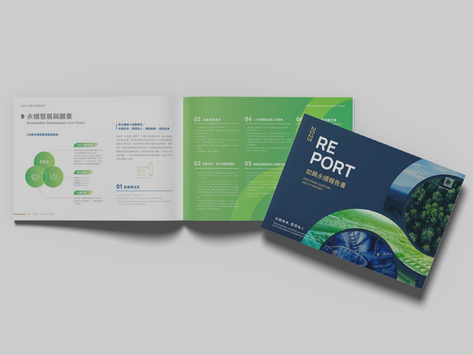
Roo Hsing|Textile Listed Company ESG Report
Annual sustainability disclosure document for a listed textile manufacturer
As a listed textile manufacturer, Roo Hsing's ESG report needed to meet listed-company disclosure requirements while covering manufacturing-specific environmental indicators (energy use, water, waste management) and governance. We helped integrate cross-departmental sustainability data, completing the report with a clear layout structure aligned to the expectations of regulators and investors.
Our team brings 30 years of industry experience · Trusted by 1,000+ brands · Handled by a senior designer, start to finish
Book an Emissions Inventory Consultation
Tell us your company size and disclosure goals — we'll give you a clear inventory scope recommendation and timeline.